December 02 2025 at 04:39AM
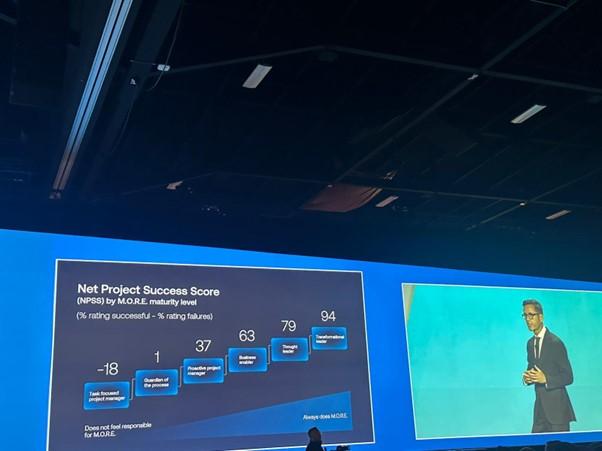
If M.O.R.E. leads to 94% NPSS, why aren’t more project managers applying it?
PMI’s global Maximizing Project Success research - its largest study ever conducted - has reshaped how we understand success and how we, as a profession, must evolve to consistently deliver value.
At the PMI Global Summit 2025, one message came through loud and clear: The more M.O.R.E. you apply, the more your project success rate increases.
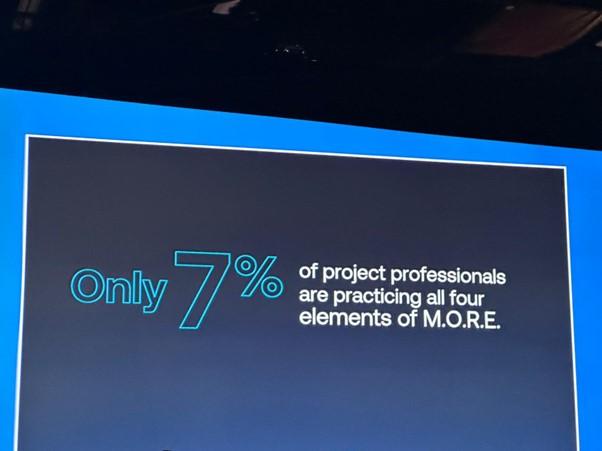
Yet, today, only 7% of project professionals incorporate all four elements of M.O.R.E. into their practice. This small minority is seeing dramatically higher success rates. The question for the profession is simple: what could happen if more of us embraced M.O.R.E.?
A New Era of Project Success
PMI’s latest research redefines success beyond the traditional iron triangle. Instead, success is now defined as delivering value that was worth the effort and expense.
This definition integrates execution and outcomes, quantitative metrics and stakeholder perceptions.
Stakeholders, particularly customers and beneficiaries, now hold twice as much influence over the perception of success as internal project roles. This means that how people experience a project matters as much as how well it was delivered.
To enable professionals to meet this new bar, PMI introduced the M.O.R.E. framework, a mindset designed to maximize value delivery, stakeholder alignment, and long-term impact.
Introducing the M.O.R.E. Framework
PMI’s M.O.R.E. framework consists of four interconnected principles that elevate how project professionals approach decision-making, communication, and leadership.
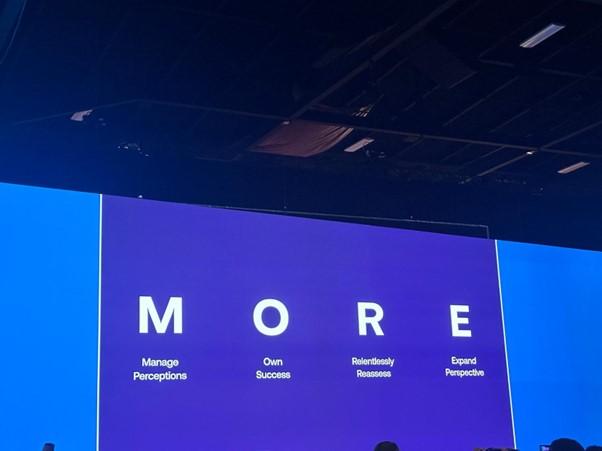
M — Manage Perceptions
Success is not only measured by KPIs, but by how stakeholders perceive the value delivered.
PMs must actively engage stakeholders, communicate benefits clearly, and tailor communication to diverse audiences. The Global Summit slides clearly showed that perception gaps lead to misalignment, resistance, and ultimately lower success.
O — Own Success
PMs must move beyond literal task execution and take ownership of the entire breadth of the project. This includes understanding business value, elevating team capabilities, and proactively shaping outcomes. What’s more, PMs often either over-own (leading to team disengagement) or under-own (delivering only what is asked). True ownership lies in finding the balance that empowers both the PM and the team.
R — Relentlessly Reassess
Change is constant. Professionals must continuously evaluate project parameters, stakeholder expectations, evolving value, risks, and context. The research shows that reassessment is often inconsistent and depends heavily on organizational maturity. When PMs fail to reassess, small misalignments become major derailers.
E — Expand Perspective
Projects exist within a broader ecosystem. PMs must connect initiatives to strategy, sustainability, societal impact, and the world beyond their organization.
This was one of the most underdeveloped capabilities identified in the global data. PMs often focus on the “how” and “what”, and hardly on the “why.”
M.O.R.E. Adoption Dramatically Improves Success Rates
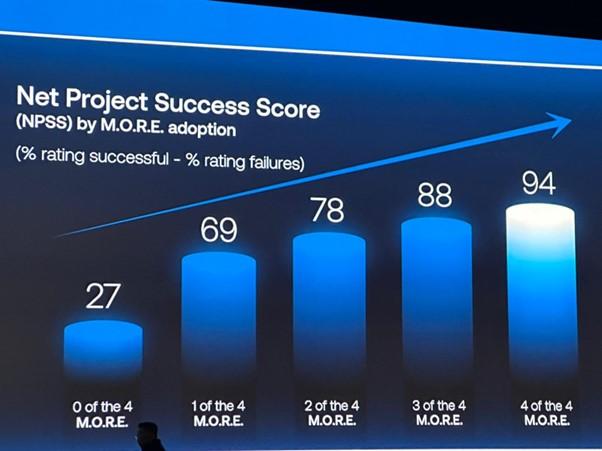
At the Global Summit, PMI showcased data demonstrating how project success increases with each additional M.O.R.E. element applied:
|
M.O.R.E. Elements Practiced |
Net Project Success Score (NPSS) |
|
0 out of 4 |
27 |
|
1 out of 4 |
69 |
|
2 out of 4 |
78 |
|
3 out of 4 |
88 |
|
4 out of 4 |
94 |
A staggering increase: a project applying all four M.O.R.E. principles is 3.5× more successful than a project applying none. Yet, today…Only 7% of project professionals practice all four M.O.R.E. elements.
This creates a huge opportunity for the PMI chapters worldwide to close the gap.
Why Aren’t More PMs Using M.O.R.E.?
Across the global sessions, workshops, and chapter feedback, PMI identified key barriers:
- Skills and soft-skill gaps. PMs often lack business acumen, communication, negotiation, stakeholder management and the ability to translate value into business terms.
- Organizational culture. Many organizations remain scope-centric or method-centric, undervaluing strategy alignment and value delivery.
- Lack of clear success metrics. Many teams still don’t define success criteria early, track progress throughout, or establish performance systems.
- Limited understanding of strategic and social impact. PMs often struggle to articulate how their project contributes to broader missions, sustainability goals, or enterprise strategy.
- Reactive work habits. In certain regions, teams jump to execution and undervalue planning and perception management.
How PMI’s Additional Research Findings Reinforce the M.O.R.E. Framework
PMI’s Maximizing Project Success research uncovered two major findings that strongly reinforce why the M.O.R.E. framework is essential for modern project success. Although these insights stand on their own, they are deeply intertwined with the four elements of M.O.R.E., strengthening the case for adopting the full mindset.
- Measurement doubles success — and this directly supports “R” and “O”
Projects that define success criteria upfront, implement a performance measurement system and track progress consistently achieve significantly higher success rates.
This is Relentlessly Reassess (R) in action: continuously checking value, alignment, and progress.
It is also Own Project Success (O): taking accountability for deliverables, outcomes, transparency, and decision-making.
Only 37% of projects do all three measurement steps, mirroring the low global adoption rates of M.O.R.E. This finding confirms: without R and O, projects operate blindfolded and fall behind.
- Social impact boosts customer satisfaction — and this is the heart of “E” and “M”
The research revealed that projects aligned with social impact deliver dramatically higher customer satisfaction (55% vs. 33%). Why?
Social impact broadens the project’s value beyond internal goals (Expand Perspective – E) and strengthens how stakeholders perceive the project’s worth (Manage Perceptions – M)
And since customers have twice the influence on success perception compared to other groups, this insight directly connects to M.O.R.E.’s emphasis on stakeholder-centricity.
Only 22% of projects include social impact as a success criterion - again mirroring the small percentage applying M.O.R.E. fully.
The Call to Action: A Global Movement Toward M.O.R.E.
PMI sees M.O.R.E. as a movement. During the workshop “Results from: Bringing MORE Value to the Profession: Your Role in Sparking a Movement Around Project Success at Latin America LIM” (February 21, 2025), Brantlee Underhill and Edivandro Conforto emphasized several actions to accelerate M.O.R.E. adoption.
For PMI Chapters
- Provide soft-skill training, business acumen workshops, and value-focused sessions
- Offer mentoring, coaching, and leadership development
- Share best practices and success stories
- Partner with organizations to improve understanding of PM value
- Bring M.O.R.E. into PMO discussions, community events, and corporate engagements
- Advocate for strategic alignment, sustainability, and value-based measurement
For PMI Global
- Provide toolkits, templates, and case studies
- Translate materials into regional languages
- Provide ambassador programs and regional support
- Offer ongoing training for chapter leaders
- Strengthen chapter-PMI feedback loops
The Future of Project Success Depends on What We Choose to Do Next
The evidence is undeniable: when project professionals embrace the full M.O.R.E. mindset, success accelerates. Yet with only 7% of practitioners using all four elements, the vast majority of our global community is leaving extraordinary potential untapped.
Every project you lead shapes outcomes for your organization, your stakeholders, and your world. Every decision to manage perceptions, own success, reassess proactively, and expand your perspective brings you closer to the level of impact the top 7% are already delivering.
Imagine a PM community where 7% becomes 20%. Then 50%. Then 100%.
Imagine the collective ripple effect on project success - and on society itself.
The movement has already begun. The only question remaining is: “What would happen if you started using it today?”
Now is the moment to step forward, to raise the standard and to define your role as a changemaker.
Choose to do M.O.R.E. - your next project deserves nothing less.
Read the PMI’s Maximizing Project Success research, and then, explore courses.