March 05 2026 at 11:40AM
Introduction to the PMBOK Guide Eighth Edition part 2
The following article is the second in a series to increase your level of understanding about the PMBOK Guide Eighth edition.
This article is the second in a series designed to help you deepen your understanding of the PMBOK Guide Eighth edition
In my previous article, I walked you through the overall structure of the PMBOK Guide Eighth Edition. So, now let´s dive a bit deeper into Book one, the Standard for Project Management.
And if you haven´t downloaded your complimentary PMI-member copy of the new PMBOK Guide yet, you can get it here.
PMBOK Guide Eight edition and how it relates to previous Editions
Before diving into Book One, it’s worth pausing for readers familiar with earlier editions.
For that, I found in the PMBOK Guide Eighth edition a very insightful picture, Figure X5-1 (page 256), clarifying the integration of:
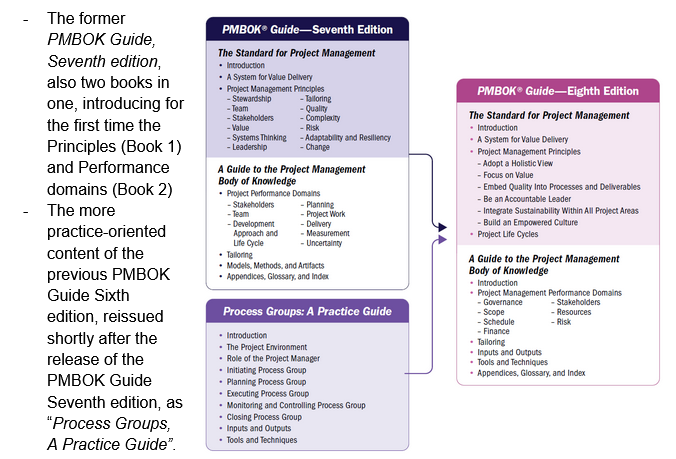
When the PMBOK Guide Seventh Edition, appeared, the project management community reacted strongly in response to the major change of the structure that worked for nearly 25 years :
- What happened to all the processes!?
- Where are all the handy tools and techniques!?
- What´s the logic of these new Performance domains?
- Huh ….???
In recognition of this, PMI responded rather quickly and released this additional publication “Process Groups, A Practice Guide”, essentially a reorganized version of all the content of the PMBOK Guide Sixth edition (containing the Processes, Inputs, Outputs, Tools and Techniques again). However, as in the Seventh edition, the former Knowledge Areas were not used anymore, as we now had Principles and Performance Domains, their content was reorganized following the structure of ´old´ Process groups: Initiating, Planning, Executing, Monitoring and Control and Closing.
Ideal? No! As the Knowledge areas (Scope, Time, Cost, Resources, etc. ….) provided a far more intuitive logical structure for defining “What do we need to manage as a PM?” But then again, something was certainly better than nothing ….!
And this is a good start, especially when fulfilling the project manager role for the very first time. Because in that case it´s definitely useful to better understand what your role actually is, what you´re supposed to be managing, and having some structure, guidance, and best practices for how to do that. Unlike becoming a doctor or a train driver, most project managers never receive formal education before they are suddenly expected to lead projects. In practice, many fall into´ the role by accident, and learning as they go, often the hard way.
When I first encountered the PMBOK Guide in 1999, after more than a decade working in project environments, my immediate response was: “Why didn´t anyone tell me this 10 years ago?!” Since then, the PMBOK Guide has been my companion for over 25 years, and for thousands of professional colleagues around the world, in creating a very practical, handy and reusable structure for managing projects, programs and portfolios; actually, all work that is related to realizing strategy, change, innovation, delivering unique results, …., containing a lot of uncertainty, as opposed to ´operations´ or ´business as usual´, which thrives on standards and routines for improved predictability and efficiency,.
With millions of copies sold of all earlier editions of the PMBOK Guide, it has become the de facto global standard for the Project Management profession. ISO even used it as a leading reference and foundation for publishing its first ISO standard on project management, ISO 21500:2012, later replaced by ISO 21502, together with an updated ISO 21500 (the ISO 21500 range together forms the broader group of ISO standards related to the project management profession).
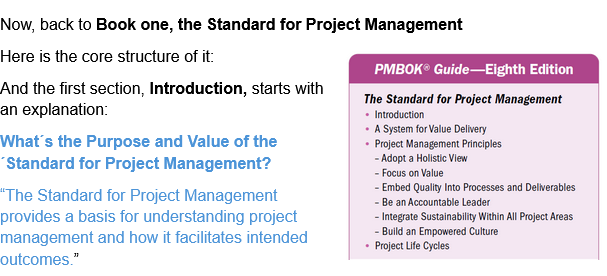
“The Standard for Project Management serves as a foundational guide for project management practitioners, providing a common language and framework that can be applied across various industries, methodologies, and technological advancements.”
Also, this is a good approach! Because in practice, I experienced that a common language is crucial for successful teamwork and delivery, especially in projects, where at the start everyone seems to have a vague idea of what we´re actually trying to create together as a team, but where there is still a lot of uncertainty about what exactly, what not, and how to develop that. Add unclear terminology, and confusion quickly becomes the silent killer of success.
So, before ´rushing into action´, teams first need to align on:
- which shared terminology we´ll use in the context of our project (key terms and concepts, framework, models, …)
- how we´ll structure our work, to ensure we properly cover and manage all key-aspects (performance domains)
- which approach is then best aligned with our type of project and the environment we´ll work in (our high-level development approach, predictive, agile, hybrid, …),
- and which processes, tools and techniques we´re going to use to ensure the quality of our work (delivering the right thing, the right way!).
This will accelerate collaboration, since people don’t need to constantly translate or clarify what they´re actually meaning with what they say. It also builds trust and cohesion, which makes people feel aligned, included, and motivated. Eventually, this boosts team effectiveness (doing the right things) and efficiency (doing it the right way).
In nearly every workshop or training I deliver, I start with a deceptively simple question: “What is a project, and what is not a project?” You would be amazed at the variety of answers. And if we can´t agree on what a project is, how on earth can we even try to manage that? As a project manager, as a team, or as an organization, …? So, that´s why Section 1 of Book One is so valuable. It provides (1.2) Key Terms and Concepts and (1.3) Foundational elements of Project Management.
And it’s not just a good read for newcomers; even experienced PMs will find new insights, especially because PMI has updated key definitions, including the definition of a project itself.
And with that, we wrap up this second article in our journey through the PMBOK® Guide and its core structure. If you’re curious to explore further, keep an eye out for the April Newsletter, where we’ll continue unfolding the story behind the PMBOK Guide Eighth Edition.
Author’s Bio
Anton Zandhuis, Associate Partner at threon, is an experienced project management professional, author, PMI-ATP-certified trainer, and co-founder of the PMI Netherlands Chapter, with over 35 years of experience in project, program, and portfolio management. He co-authored globally recognized publications, including A Pocket Companion to PMI’s PMBOK® Guide and ISO 21500 – A Pocket Guide. Anton helps professionals translate and integrate recognized frameworks into pragmatic solutions that deliver real business value and help you realize your strategy.
About Threon - www.threon.com

We help organizations manage uncertainty through flexible, focused portfolios—built on strong foundations, scenario planning, and clear decision frameworks. Together, we get your strategy delivered.
We’ve supported the PMI Netherlands Chapter for over 25 years, actively contributing as a Chapter Partner. We believe in the Chapter’s value: promoting best practices, peer networking, and professional development for individuals and organizations. And because we care—so we share!
Threon’s last PMP® training opportunity before the PMP exam changes in July 2026.

PMP® - Certification Preparation - Breda
Monday16 March – Friday 20 March, 2026
9:00 – 17: 00 (CET)
Delivered by Anton Zandhuis, PMI-ATP certified instructor
More information here