April 02 2026 at 03:43AM
Journey through the PMBOK Guide Eighth Edition – part 3
This article is the third in a series designed to help you deepen your understanding of the PMBOK Guide Eighth edition. And again, if you haven´t downloaded your complimentary PMI-member copy of the new PMBOK Guide yet, you can get it here.
In my previous article we introduced the structure of the PMBOK Guide 8th edition, its value and key terminology. In this article we will continue with Book one, the Standard for Project Management, but now for positioning projects in the broader, strategic context of an organization. Because delivering a project is not a purpose in itself. Strategy realization is all about making the right changes in the best possible way. Therefore, delivering the right projects successfully is an essential means for realizing the organizational strategy. Because the projects enable realization of new organizational capabilities. Interesting here is the explicit mention of ´societal impact´ which immediately refers to the so-called Principles covered in Section 3 of Book one, ‘The Standard for Project Management’.
Project Management Principles
“Principles for a profession serve as foundational guidelines for strategy, decision-making, and problem-solving. Professional standards and methodologies often derive from these principles. In some professions, principles act as prescriptive laws or rules. However, the principles of project management are not prescriptive, but rather are intended to reinforce the mindset and guide the behavior of people involved in projects. This standard is a “principle-based” standard.”
First some background information about the development of PMBOK Guide over time, to help you understand why we are where we are today …
With every new edition the volume of the PMBOK Guide was growing, and with the Sixth edition they even added a separate Standard, The Agile Practice Guide. In total more than 1000 pages! So, when preparing the Seventh edition, PMI concluded that the structure PMBOK Guide needed to change. In the Seventh edition PMI characterized project management as a “system for value delivery” shifting toward a more holistic, value-oriented mindset, and taking a less process-based and output-oriented perspective. And this was also where for the first time the concept of Project Management Principles was introduced, changing the PMBOK Guide from a process-based standard to a principle-based standard. This was a major change! But as a consequence also causing much criticism from the professional audience, being used before that time to a structure of 5 Process Groups, 10 Knowledge areas, and under these, a bunch of processes. And everyone who studied for the PMP exam up to the Sixth edition still knows this structure by heart; it was logical!
With hindsight, the Seventh edition can be seen now as a nice draft, but the logic and structure of the new Principles and Performance domains were not mature enough yet. It was some sort of a mixture of the former Knowledge areas and Process groups, containing much overlap, and the rationale behind each Principle and Performance domain was not always that clear, and sometimes even a bit illogical.
But now, compared to the Seventh edition, the Eighth edition can be regarded as a pretty mature reference, with a far easier to understand logic of the structure again, and with a clear and well explained rationale for the split between Principles and Performance domains, especially for professionals having studied and worked with the earlier PMBOK Guide editions, up to the Sixth.
Now, let´s have a closer look at Mindset and Principles
“Collectively, these principles describe the mindset of project management, which in turn guides the mechanics of project management.”
And
“A mindset is a set of beliefs, ways of thinking, and habits that make sense of the behaviors and views of others as well as a way to interpret and deal with various situations.”
Creating the right mindset is more beneficial than only defining processes and tools because a mindset guides behavior even when rules or tools are absent. This perfectly reflects a project environment, as there is not one book with rules on how to realize a project. Processes and tools tell people what to do and how to do it, but a mindset tells them why it makes sense doing it, which is crucial for consistently realizing objectives in complex environments.
With the right mindset, people can adjust to new situations instead of rigidly following processes which were never designed for that specific situation. A shared mindset also helps individuals and teams making good choices without the need of detailed instructions or approvals, thus preventing delay in execution and delivery, and encouraging teams taking responsibility and act proactively, instead of “just following the rules.” Also processes and tools often need to be adapted in context of the objective, and a strong mindset continues to drive the objective forward in a sustainable manner.
This perfectly reflects a holon-type organization, which combines the flexibility of decentralization with the coherence of a unified system, making it well suited for complex and fast-changing environments. In a holon type organization, each unit is both a whole on its own and part of a larger whole. This approach offers several strong benefits:
- Greater autonomy with alignment: Teams can make local decisions quickly while still supporting the overall organizational purpose.
- Faster responsiveness and adaptability: Because holons are semi-independent, the organization can react to change without waiting for top-down approval.
- Scalability: New teams or units can be added without redesigning the entire structure, making growth smoother.
- Resilience: If one holon struggles or fails, the rest of the organization can continue operating with minimal disruption.
- Higher engagement and ownership: People feel responsible for outcomes, not just tasks, which boost motivation and accountability.
- Reduced bureaucracy: Decision-making is distributed, cutting down on layers of management and slow approval processes.
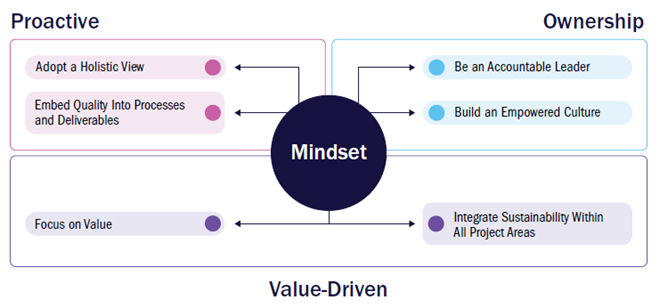
Section 3.1 of Book 1 elaborates on the Project Management Mindset, while also introducing the six Principles themselves. This is nicely visualized in Figure 3-1. The Project Management Mindset
And with this Mindset, we wrap up this third article in our journey through the PMBOK® Guide and its core structure. If you’re curious to explore further, keep an eye out for the May Newsletter, where we’ll dive deeper into the individual Principles in the PMBOK Guide Eighth Edition.
About the Author
Anton Zandhuis, Associate Partner at threon, is an experienced project management professional. A PMI-ATP-certified trainer, author and co-founder of the PMI Netherlands Chapter, with over 35 years of hands-on experience in project, program, and portfolio management. He co-authored several internationally recognized publications, including A Pocket Companion to PMI’s PMBOK® Guide and ISO 21500 – A Pocket Guide. Today, Anton works with leadership teams and project, program and change managers to translate proven frameworks into pragmatic strategy-enabling solutions, bridging theory and real-world execution to accelerate their business performance.
Just reach out to me if you want to connect: linkedin.com/in/antonzandhuis
About Threon - www.threon.com
We help organizations manage uncertainty through flexible, focused portfolios—built on strong foundations, scenario planning and clear decision frameworks. Together, we will get your strategy delivered.
We’ve supported the PMI Netherlands Chapter for over 25 years, actively contributing as Chapter Partner. We believe in the Chapter’s value: promoting best practices, peer networking and professional development for individuals and organizations. And because we care—so we share!
Our PMP Summer class will be your first training opportunity for the updated PMP exam!
Join threon’s very first PMP exam preparation Summer class, delivered with the newly updated, official PMP® learning materials, aligned with the PMBOK Guide 8th edition. You will benefit from the most up‑to‑date content, examples, and exam‑oriented preparation.
Enjoy a multi‑day learning experience, including overnight stay and all meals, hosted in a beautiful and relaxing environment that supports deep focus and meaningful learning.
PMP® - Certification Preparation – Summer class
Tuesday 18 August – Friday 21 August, 2026
Delivered by Anton Zandhuis, PMI-ATP certified instructor
More information here